
Üye Girişi
ESP32-S2/S3 ve PCM5102 ile Hi-Fi USB Ses Kartı Yapımı
ESP32-S2/S3 ve PCM5102 ile Hi-Fi USB Ses Kartı Yapımı
Standardı klasik ESP32 (WROOM) olan modeller donanımsal bir USB çevre birimine sahip olmadığı için doğrudan bilgisayara bir USB cihazı olarak bağlanamazlar. Ancak yerleşik USB donanımına sahip olan ESP32-S2 veya ESP32-S3 modellerini, yüksek kaliteli harici bir PCM5102 I2S DAC entegresiyle birleştirerek bilgisayarınız için sürücü gerektirmeyen (UAC - USB Audio Class) harika bir harici ses kartına dönüştürebilirsiniz.
Bu projede bilgisayardan gelen dijital ses verileri ESP32'nin USB birimi üzerinden alınacak, ardından I2S (Inter-IC Sound) protokolü ile PCM5102 kod çözücüsüne aktarılarak analog ses çıkışına (3.5mm jak) dönüştürülecektir.
1. Donanım Bağlantı Şeması
ESP32'nin bilgisayara doğrudan USB üzerinden bağlanması ve PCM5102 DAC modülü ile iletişim kurması için yapılması gereken bağlantılar şu şekildedir:
A. USB Bağlantısı (Bilgisayar - ESP32)
ESP32-S2/S3 çipinin doğrudan yerleşik USB-OTG hattı kullanılmalıdır. Kart üzerindeki CH340 veya CP2102 gibi harici USB-UART köprü entegrelerine bağlı olan USB portları bu projede kullanılamaz.
- GPIO 19 -> USB D- (Beyaz kablo)
- GPIO 20 -> USB D+ (Yeşil kablo)
- 5V / GND -> USB 5V ve GND hatları
B. I2S Ses Bağlantısı (ESP32 - PCM5102)
PCM5102 modülünün yüksek kaliteli çalışması ve harici bir sistem saatine (MCLK) ihtiyaç duymaması için modül üzerindeki SCK (System Clock) pini GND hattına köprülenmelidir. Bu sayede modül, dahili saatini PLL ile kendisi üretir (Internal Clock Mode).
- GPIO 4 (I2S LRCK / WS) -> PCM5102 LCK
- GPIO 5 (I2S BCLK / BCK) -> PCM5102 BCK
- GPIO 7 (I2S DATA / DOUT) -> PCM5102 DIN
- GND -> PCM5102 GND & SCK
- 3.3V -> PCM5102 VCC
2. Kullanılan Kütüphaneler ve Görevleri
Bu projenin hatasız derlenebilmesi için doğru kütüphane altyapısının kurulu olması şarttır. Projede kullanılan kütüphaneler dışarıdan harici olarak indirilmez; tamamı Espressif Resmi ESP32 Core paketinin içerisinde yerleşik (built-in) olarak gelir.
- driver/i2s.h : ESP32'nin donanımsal I2S sürücüsünü kontrol eder. Bilgisayardan gelen dijital ses verilerini PCM5102 DAC entegresinin anlayacağı protokol biçimine dönüştürerek pinlere aktarır.
- USB.h : ESP32-S2 ve S3 çiplerinin içerisinde bulunan yerleşik USB OTG donanım katmanını (Stack) başlatır ve yönetir.
- USBAudioCard.h : USB yığınının üzerinde çalışan UAC (USB Audio Class) protokolünü aktif eder. Bilgisayarın ESP32'yi ek bir sürücüye ihtiyaç duymadan "Hoparlör / Ses Kartı" olarak tanımasını sağlayan asıl kütüphane budur.
Sürüm Notu: USBAudio.h kütüphanesinin sorunsuz çalışabilmesi için Arduino IDE üzerindeki ESP32 kart yöneticisi sürümünüzün güncel olması gerekir. Bu kütüphane resmi olarak ESP32 Arduino Core v2.0.x ve v3.0.x sürümlerinde desteklenmektedir.
3. Projenin Tam Kod Yapısı
Aşağıdaki kod, bilgisayardan 16-bit 48kHz (CD Kalitesi) stereo ses verisini USB üzerinden yakalar ve anlık olarak I2S hattı üzerinden PCM5102'ye basar:
// Copyright 2015-2026 Espressif Systems (Shanghai) PTE LTD
//
// Licensed under the Apache License, Version 2.0 (the "License");
// you may not use this file except in compliance with the License.
// You may obtain a copy of the License at
//
// http://www.apache.org/licenses/LICENSE-2.0
//
// Unless required by applicable law or agreed to in writing, software
// distributed under the License is distributed on an "AS IS" BASIS,
// WITHOUT WARRANTIES OR CONDITIONS OF ANY KIND, either express or implied.
// See the License for the specific language governing permissions and
// limitations under the License.
/*
USB Audio Card bridge (device mode)
The MCU presents itself as a USB sound card. Audio flows in two directions:
- Playback (host → speakers): the PC sends PCM over USB. USBAudioCard calls
onSpkData() with each chunk; we apply host volume and push samples to I2S
so an external DAC/codec can drive speakers.
- Capture (microphone → host): we read PCM from I2S (ADC/codec mic path) and
call uac.write() so the host can record it.
Startup order: configure I2S first, then register callbacks and start the
audio device; finally start the USB stack so enumeration can complete.
*/
#include <Arduino.h>
#include "ESP_I2S.h"
#include "USB.h"
#include "USBAudioCard.h"
// I2S pinout and sample format depend on the chip: S2/S3 uses 16-bit I2S matching
// UAC 16-bit; P4 uses 32-bit slots with 24-bit effective UAC data.
#if CONFIG_IDF_TARGET_ESP32S3 || CONFIG_IDF_TARGET_ESP32S2
#define I2S_BCLK 5
#define I2S_LRCK 4
#define I2S_DOUT 7
#define I2S_DIN 6
#define I2S_WIDTH I2S_DATA_BIT_WIDTH_16BIT
#define UAC_BPS UAC_BPS_16
#elif CONFIG_IDF_TARGET_ESP32P4
#define I2S_BCLK 0
#define I2S_LRCK 1
#define I2S_DOUT 2
#define I2S_DIN 3
#define I2S_WIDTH I2S_DATA_BIT_WIDTH_32BIT
#define UAC_BPS UAC_BPS_24
#else
#error This example is not supported on the selected hardware
#endif
// Default 48 kHz stereo in/out; UAC_BPS must match I2S_WIDTH for correct sample size.
USBAudioCard uac(48000, UAC_BPS, UAC_SPK_STEREO, UAC_MIC_STEREO);
I2SClass i2s;
// Staging buffer for one loop() iteration of mic samples (see toRead in loop()).
uint8_t inputBuffer[1024];
// Single callback for USB link state and UAC controls (volume, mute, rate, alt settings).
static void usbEventCallback(void *arg, esp_event_base_t event_base, int32_t event_id, void *event_data) {
if (event_base == ARDUINO_USB_EVENTS) {
arduino_usb_event_data_t *data = (arduino_usb_event_data_t *)event_data;
switch (event_id) {
case ARDUINO_USB_STARTED_EVENT: Serial.println("USB PLUGGED"); break;
case ARDUINO_USB_STOPPED_EVENT: Serial.println("USB UNPLUGGED"); break;
case ARDUINO_USB_SUSPEND_EVENT: Serial.printf("USB SUSPENDED: remote_wakeup_en: %u\r\n", data->suspend.remote_wakeup_en); break;
case ARDUINO_USB_RESUME_EVENT: Serial.println("USB RESUMED"); break;
default: break;
}
} else if (event_base == ARDUINO_USB_AUDIO_CARD_EVENTS) {
arduino_usb_audio_card_event_data_t *data = (arduino_usb_audio_card_event_data_t *)event_data;
switch (event_id) {
case ARDUINO_USB_AUDIO_CARD_VOLUME_EVENT: Serial.printf("AUDIO VOLUME CH: %d, DB: %d\r\n", data->volume.channel, data->volume.db); break;
case ARDUINO_USB_AUDIO_CARD_MUTE_EVENT: Serial.printf("AUDIO MUTE CH: %d, MUTED: %d\r\n", data->mute.channel, data->mute.muted); break;
case ARDUINO_USB_AUDIO_CARD_SAMPLE_RATE_EVENT: Serial.printf("AUDIO SAMPLE RATE: %lu\r\n", data->sample_rate.rate); break;
case ARDUINO_USB_AUDIO_CARD_INTERFACE_ENABLE_EVENT:
Serial.printf("AUDIO INTERFACE: %s, ENABLED: %d\r\n", data->interface_enable.interface ? "MIC" : "SPK", data->interface_enable.enable);
break;
default: break;
}
}
}
// BOOT button: debounced edge detect toggles USB master mute (does not affect I2S hardware).
void checkButton() {
#if CONFIG_IDF_TARGET_ESP32P4
// Poll every 50ms
const uint32_t interval_ms = 50;
static uint32_t start_ms = 0;
if (millis() - start_ms < interval_ms) {
return;
}
start_ms += interval_ms;
static uint32_t btn_prev = 0;
uint32_t btn = digitalRead(BOOT_PIN);
if (!btn_prev && btn) {
// Mute/Unmute UAC2
uac.mute(UAC_CHAN_MASTER, !uac.mute(UAC_CHAN_MASTER));
}
btn_prev = btn;
#endif
}
// Invoked when the host sends playback PCM: apply UAC volume curve, then output on I2S.
void onSpkData(void *data, uint16_t len) {
uac.applyVolume(data, len);
i2s.write((const uint8_t *)data, len);
}
void setup() {
pinMode(BOOT_PIN, INPUT);
Serial.begin(115200);
i2s.setPins(I2S_BCLK, I2S_LRCK, I2S_DOUT, I2S_DIN);
i2s.begin(I2S_MODE_STD, 48000, I2S_WIDTH, I2S_SLOT_MODE_STEREO, I2S_STD_SLOT_BOTH);
uac.onEvent(usbEventCallback);
uac.onData(onSpkData);
uac.begin();
// Stack-wide USB events (same handler also receives ARDUINO_USB_AUDIO_CARD_EVENTS above).
USB.onEvent(usbEventCallback);
USB.begin();
}
void loop() {
checkButton();
// Capture path: read ~1 ms of mic PCM from I2S, then send to the USB IN endpoint.
size_t toRead = (uac.sampleRate() * uac.micChannels() * uac.bytesPerSample()) / 1000;
if (toRead > sizeof(inputBuffer)) {
toRead = sizeof(inputBuffer);
}
size_t received = i2s.readBytes((char *)inputBuffer, toRead);
if (received > 0) {
uac.write(inputBuffer, (uint16_t)received);
}
}
4. Kritik Arduino IDE Ayarları (Yüklemeden Önce)
Kodun dahili USB aygıtı mimarisiyle derlenebilmesi için Arduino IDE üzerinde Tools (Araçlar) menüsünden şu seçenekleri mutlaka doğru yapılandırmalısınız:
- Board: "ESP32S3 Dev Module" (veya elinizdeki spesifik S2/S3 varyantı).
- USB CDC On Boot:
Disabled. - USB Msc On Boot:
Disabled. - USB DFU On Boot:
Disabled. - Upload Mode:
"UART0 /Hardware CDC". - Usb mode : "USB-OTG(tinyUSB)
5. Bilgisayara Bağlama ve Test
- Kodu ESP32'ye başarıyla yükledikten sonra, hazırladığınız yerleşik USB veri hatlarını (GPIO 19 ve 20'ye giden kabloyu) bilgisayarın USB portuna takın. En temizi çift USB'li kart kullanmak.
- İşletim sisteminizin ses ayarlarına (Sağ alttaki hoparlör simgesi) girin.
- Çıkış aygıtları listesinde otomatik olarak tak-çalıştır tanınan "TinyUSB UAC1" adında yeni bir ses kartı göreceksiniz. Genelde takınca aktif olur.
- Bu aygıtı varsayılan çıkış olarak seçip PCM5102 modülünün 3.5mm kulaklık çıkışından parazitsiz, kristal netliğinde ses çıkışı alabilirsiniz.
- PCM5102 32 bit olmasına rağmen ESP32S3 ün yetersizliklerinden dolayı 16 bit kullanılmaktadır. 32bit ses isterseniz mikrofonu kapamanız gerekir (UAC_MIC_NONE). Ses kalitesi gayet iyidir.
6. Sorun Giderme
- PCM5102 den ses alamıyorsanız modülün arkasındaki lehim jumperlerini lehimlemeniz gerekir. H3L 3v3'e diğerleri GND'ye lehimlenmelidir.
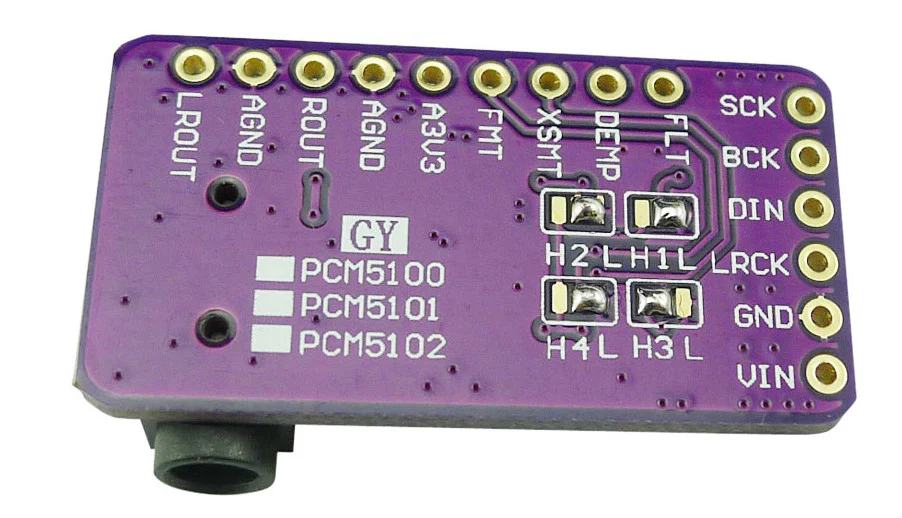
- H3L XSMT ye bağlıdır isterseniz dışarıdan da kablo atabilirsiniz. Projenizde MUTE ihtiyacınız olursa kablo ile 3v3 vermeniz daha doğru olur.
- 32 Bit ses için mutlaka mikrofonu kapatınız, yoksa ses çıkışı alamazsınız (UAC_MIC_NONE).
- Eğer daha önce usb ses denemeleriniz olduysa bilgisayar esp32s3'ü eski isimde aygıt sürücüsüne ekleyebilir. Bu durumda aygıtı kaldırıp yeniden taratarak yüklemelisiniz.
- Sistem Windows11 de test edilmiştir. ESP3.3.10 da derlendi. ESP kütüphane adları ile oynamayı çok seviyor, versiyonlarda sorun çıkma ihtimali çok yüksek.
- PCM5102 SCK pinini mutlaka şaseye vermelisiniz. PCM5102'nin senkronizasyonu için gereklidir.
💬 Yorumlar
Henüz yorum yapılmamış. İlk yorumu siz yapın!